

Treating Small Breasts: Hypomastia And Amastia Care
Every woman deserves to feel at home in her body. For women living with very small or absent breasts, that feeling can be hard to find. Hypomastia means underdeveloped breasts. Amastia means a complete absence of the breast, nipple, and areola. Both can affect one or both sides. Both can influence confidence, clothing choices, and daily life. Dr. Michael Baumholtz, Cirujano plástico en San Antonio, Texas, meets women with these concerns every week. He focuses on safe surgery, realistic planning, and long term follow up. His approach is steady, direct, and patient first.
He brings dual board certification in General Surgery and Plastic Surgery. He trained in hand and microsurgery. He has years of experience in high volume trauma centers. That background shows in the way he plans, measures, and communicates. In San Antonio, Dr Michael Baumholtz uses clear language, careful technique, and a calm process to help women with hypomastia and amastia move toward results that fit their bodies and goals.
¿Listo para cirugía? Tome el Dr. Baumholtz Breast Cirugía Quiz
What These Conditions Mean
Hypomastia describes abnormally small breast development. In plain terms, the breast tissue is present, but limited. Amastia is rarer and means no breast tissue, no nipple, and no areola. Either may be unilateral or bilateral. These definitions matter because they influence surgical planning and expectations. Hypomastia is a size and shape problem. Amastia is a reconstructive problem that starts from zero.
Some women have a related chest wall difference called Poland syndrome. It can involve missing or thin pectoral muscles and rib differences, and it often pairs with breast absence on one side. Recognizing that pattern helps set a safe plan.
Why The Emotional Story Matters
Small or absent breasts can ripple through daily life. Clothes do not fit as expected. Swimwear feels daunting. Intimacy can feel complicated. Many women describe years of workaround habits that never feel right. In San Antonio, Dr Michael Baumholtz acknowledges this emotional load during consultation. He talks through goals, limits, and tradeoffs. He explains how surgery can help and where nature still sets the rules. His practice centers honest discussion over hype. That tone carries through the entire journey.
How Dr Michael Baumholtz Builds A Plan
Every plan starts with anatomy. He measures base width, reviews chest wall shape, and examines skin quality. He separates problems of volume from problems of position. That simple framework guides safe decisions. He uses 3D planning for breast surgery and asks each patient to bring a private wish book of real, unclothed photos that show a look they like on bodies similar to their own. He does not chase cup size. He avoids fixating on implant ccs in isolation. He matches the device to the body and the body to the goal.
For hypomastia, there is usually some native tissue to shape and support. For amastia, he is often creating the entire breast mound, pocket, and footprint. That raises the bar for precision. It also raises the need for clear conversations about stages, scars, and recovery.
Implant Choices Explained In Real Terms
Most women with hypomastia choose silicone implants because they feel more like natural breast tissue and ripple less in thin patients. Saline remains an option, especially for women under 22 where FDA approvals differ by fill material. Saline implants are approved at 18 years. Silicone gel implants are approved for augmentation at 22 years and older. For reconstructive needs related to congenital differences, surgeons may use silicone sooner based on clinical judgment. Screening for silicone implants includes ultrasound or MRI starting at 5 to 6 years after placement and every 2 to 3 years afterwards.
En Dr Baumholtz’s San Antonio practice, he prefers smooth round implants. He does not use macro textured devices because of the rare association between textured implants and breast implant associated anaplastic large cell lymphoma. He discusses that risk, and he puts it in context as rare and typically slow moving. Patients should seek evaluation for any late swelling, pain, or a new mass in one breast. The FDA has also reported very rare cancers in the capsule that are distinct from BIA ALCL. Routine removal is not recommended for women without symptoms, but awareness is important.
Silicone or saline, Dr Michael Baumholtz matches implant diameter to breast base width first. Then he adjusts projection to meet the look the patient shows in her wish book and the reality of her tissues. That keeps choices grounded and predictable. He uses VECTRA for breast planning only, not for body imaging.
Incisions And Pocket Placement That Put Safety First
Inframammary incisions sit in the breast fold. This approach offers excellent visibility, clean handling, and reliable revision access in the future. It also allows fold repair and easy use of internal mesh when needed. Dr Michael Baumholtz strongly favors this incision for primary and revision breast surgery.
For pocket placement, he typically uses a dual plane submuscular approach. That choice softens the upper breast transition, hides medial rippling in thin women, and lowers capsular contracture risk in certain groups. It can also protect the blood supply to the nipple areola complex during later revisions. For women who want a deliberately high projection and a stuck on look, he will discuss subglandular placement, along with its tradeoffs.
He inserts implants with a Keller Funnel to minimize contact, keep the incision modest, and support sterile technique. Pocket irrigation includes saline and betadine, and he re preps the skin with betadine before device placement. These steps reflect a consistent, detail oriented approach.
When Mesh And Fat Grafting Make Sense
Modern absorbable mesh can act like an internal bra. Dr Michael Baumholtz uses mesh in thin patients who want larger implants, in augmentation mastopexy, and in revisions that need fold support or repositioning. He selects between options like DuraSorb and GalaFLEX based on how much support a case needs and how long that support should last. He avoids acellular dermal matrix for elective aesthetic cases because of cost and risk.
Fat transfer has a role for small shape corrections, minor asymmetry, or contour dents from prior biopsies. He does not use fat alone as a primary solution for women who want a clear size increase. Fat settles unpredictably, and repeat sessions can follow. For most hypomastia patients, a well chosen implant remains the faster, more reliable path to a stable result.
Special Considerations For Amastia And Complex Anatomy
True amastia often pairs with chest wall differences. In those cases, planning must respect bone, muscle, and skin limits. In some women, tissue expansion may be needed to create safe space for a device. In others, careful pocket creation and staged sizing address the tight skin envelope. When Poland syndrome is present, he may coordinate with other specialists to address underlying structural issues as part of a staged plan.
Anatomical or teardrop shaped implants are not his preference for these cases. Round devices take on a teardrop shape in the upright position, and teardrop devices require texturing with its risks and can rotate. Over time, Dr Baumholtz replaced early shaped devices with round implants and has not returned to shaped implants.
Breastfeeding, Sensation, And Candid Talks About Tradeoffs
For younger women who hope to breastfeed soon, timing matters. Dr Michael Baumholtz explains that breast surgery can compress or twist ducts even when they are not cut, which can affect future nursing. If breastfeeding is mission critical in the near term, he advises waiting. If surgery proceeds, he favors an inframammary incision with a dual plane pocket to minimize interference with the gland. He avoids periareolar incisions for implants in women who want to protect ducts and reduce contamination risk. Nipple sensation changes are uncommon, but any implant that significantly stretches tissue can annoy the nerve. That risk rises with larger devices, older age, and smoking.
Safety, Surveillance, And What The FDA Recommends
Women considering silicone implants should know the current screening advice. The FDA and radiology guidelines recommend an initial ultrasound or MRI at 5 to 6 years after silicone implant placement, then every 2 to 3 years after that. This helps find silent ruptures. For women with saline implants, rupture is obvious, since the implant deflates. Routine removal at 10 years is not recommended. Dr Michael Baumholtz offers in office ultrasound to screen silicone shells and orders MRI if a study is concerning.
He also reviews FDA labeling updates, patient checklists, and the boxed warning now included with implants. In San Antonio, women receive measured, balanced counseling on benefits and risks before any decision.
The Consultation In San Antonio
The first visit sets the tone. Dr Michael Baumholtz listens, measures, and photographs. He asks each patient to show example images of results she actually likes on bodies close to her own. Together, you review measurements and options. Base width drives diameter. Projection adjusts the look. Skin quality and tissue thickness set guardrails. VECTRA modeling is used for breast surgery to visualize differences between projections. You leave with a clear, written plan that reads like a roadmap.
How Surgery Works
On surgery day, anesthesia is provided by a board certified anesthesiologist. Dr Baumholtz uses an inframammary incision for most cases. He creates a dual plane pocket, irrigates with saline and betadine, re preps the skin, and delivers the implant with a Keller Funnel. If the fold needs to be lowered, he recreates it with three point stitches and adds absorbable mesh when needed for support. He does not use drains for aesthetic breast augmentation. He closes in fine layers and places you in a soft, front zip surgical bra.
Recovery You Can Count On
Expect a week of true downtime. Expect soreness that feels like a hard workout, especially with submuscular pockets. He uses a multimodal pain plan that combines a narcotic, a non narcotic, a muscle relaxer, anti nausea medication, an antibiotic, and a stool softener. Light walking begins day one. No lifting, pushing, or pulling more than 5 to 10 pounds until cleared. Massage usually begins at two weeks for primary augmentations, but starts later if a lift or mesh support was added. Return to unrestricted activity is typical around six weeks.
Scar care starts once the incisions are sealed. Massage, silicone based cream, and sun protection form the core of his program. Microneedling is an option as early as six weeks for patients who want to maximize scar quality.
Realistic Expectations And Revision Expertise
Dr Michael Baumholtz is best known for revision work. Women seek him out for issues like bottoming out, lateral drift, symmastia, visible rippling, and capsular contracture. He is open about why those problems happen and how to fix them. He uses mesh to rebuild the fold or reinforce weak tissue. He changes implant size and projection to better match the base width. He re establishes safe pocket planes when needed. He will not push anatomy beyond safe limits for a short term win. That mindset prevents problems now and down the line.
He also counsels women clearly on breast implant illness. He recognizes that symptoms are real for the person who has them. He avoids misleading cancer terms like en bloc for elective implant removal and instead commits to removing as much capsule as safely possible when removal is chosen. Time then shows whether symptoms improve. That is honest. It is also how trust is built.
Age, Timelines, And FDA Rules In Plain English
Women 22 and older can choose silicone for cosmetic augmentation within FDA labeling. Women 18 and older can choose saline. Younger women with congenital differences may receive silicone during reconstructive care. These are nuanced decisions made with full counseling. Dr Michael Baumholtz follows the science and the rules, and he explains them without jargon.
Life In San Antonio With Your New Shape
San Antonio is an active, outdoor city. Heat and humidity can test any recovery plan. Dr Michael Baumholtz prepares his patients for that. Plan indoor time during the first weeks. Wear the surgical bra. Avoid pools until your incisions are sealed and cleared. Protect scars from South Texas sun with clothing and high SPF. Resume workouts stepwise at six weeks, with a focus on listening to your body and protecting your results.
Why Women Choose Dr Michael Baumholtz In San Antonio
The reasons are consistent. He speaks plainly. He measures precisely. He plans from anatomy first. He uses safe, proven techniques. He operates with the same discipline on first time cases and complex revisions. He follows patients closely. He does not take insurance. He will not offer quick fixes or promises he cannot keep. He is a Plastic Surgeon who treats patients like family and treats goals like a shared project.
A Note On Textured Implants, Safety Updates, And Your Peace Of Mind
The link between macro textured implants and BIA ALCL is rare, but real. The FDA requested a recall of certain textured devices in 2019 and continues to update safety communications. Today, most cosmetic cases in the United States use smooth devices. Dr Michael Baumholtz has long preferred smooth implants and counsels accordingly. He also asks patients to return for new swelling, pain, or fluid on one side, even years later. Awareness and access to your surgeon matter.
Practical Steps Before Surgery
Stop nicotine in all forms. Reach a stable, healthy weight. Organize home help for the first week. Prepare a simple recovery space with pillows, meds, and front zip bras. Set realistic goals. Bring your wish book to your consulta. Ask every question. Share any worry. This is a partnership.
The San Antonio Path Forward
For women with hypomastia and amastia, change is possible. Skilled surgery can create proportion, restore balance, and support confidence. In San Antonio, Dr Michael Baumholtz brings time tested methods and a steady hand to that work. His practice is designed around safety, education, and long term care. His patients know what to expect before they ever see an operating room. That is the Baumholtz difference.
FAQs About Treating Hypomastia And Amastia In San Antonio
Can women under 22 ever receive silicone implants for congenital breast differences in San Antonio with Dr Michael Baumholtz?
Yes, when the need is reconstructive for a congenital difference, silicone may be appropriate with full counseling. For cosmetic augmentation, FDA approvals are saline at 18 and silicone at 22, and he explains those rules carefully at consultation.How does Dr Michael Baumholtz handle tight skin in amastia when there is no breast footprint at all?
He often stages the plan. He may use tissue expansion or a careful, dual plane pocket with strict sizing to respect the skin envelope. He sets expectations early and uses mesh support when the tissues need extra help.Does he ever choose a periareolar incision for hypomastia if the areola is small but the patient wants the scar hidden on the border?
He favors the inframammary fold for most augmentations because it lowers contamination risk, offers excellent visibility, and can be reused for future revisions or lifts. He will explain why that choice often heals best and stays most useful over time.What does follow up look like after surgery at his San Antonio practice?
He sees patients the day after surgery, then as often as needed. Massage usually begins at two weeks for standard augmentations. He watches implant position, fold stability, and scar quality, and keeps communication open between visits.If a patient wants a very athletic look with strong upper pole fullness, how does he guide implant selection?
He matches implant diameter to base width first, then adds projection to reach the look in the wish book while protecting tissue limits. He explains that going too wide or too big can push implants to the sides or lower the fold over time. Mesh support is considered when larger sizes meet thin tissues.How does he counsel about rare implant related cancers without scaring patients away from good options?
He addresses BIA ALCL and other rare capsule cancers directly, clarifies that risk is rare and tied mainly to textured devices, and explains what symptoms would prompt evaluation. He does not recommend routine removal for symptom free patients. He prefers smooth implants for cosmetic cases.What does Dr Michael Baumholtz recommend for long term implant surveillance in San Antonio?
For silicone implants, he aligns with guidance to obtain an ultrasound or MRI at 5 to 6 years after surgery and every 2 to 3 years after that. His office offers in office ultrasound screening and orders MRI if needed. For saline implants, rupture is obvious, so routine imaging is not required unless there is a concern.Referencias médicas
- Breasts and/or Nipples, Aplasia or Hypoplasia of, 1 (BNAH1) – https://www.malacards.org/card/breasts_and_or_nipples_aplasia_or_hypoplasia_of_1
- Developmental disorders and malformations of the breast – https://www.sciencedirect.com/science/article/abs/pii/S0740257018301175
- Anatomy, Thorax: Mammary Gland. StatPearls – NCBI Bookshelf. https://www.ncbi.nlm.nih.gov/books/NBK547666/
- From birth to puberty: the main physio-pathological changes of the mammary gland –https://www.sciencedirect.com/science/article/pii/S0378378225001665
- Health Benefits of Aesthetic Breast Surgery. Oxford Academic. https://academic.oup.com/asj/article/45/Supplement_2/S40/8228856
- Poland syndrome – https://eurjanat.com/articles/poland-syndrome/
- Breast Disorders in the Female Adolescent (AAP chapter PDF) – https://publications.aap.org/books/chapter-pdf/771642/aap_9781581106497-ch03.pdf
Book An Appointment
If you are considering treatment for small or absent breasts and want a straightforward conversation with a board certified Plastic Surgeon, programar una consulta privada con Dr. Michael Baumholtz en San Antonio, Texas. Call 210 660 5579 or email info@bplasticsurgery.com. Learn your options. See what fits your body and your life. Take the first step toward a plan that makes sense for you.
Cirugía Plástica Baumholz con Dr. Baumholtz en San Antonio
SOBRE DR. MICHAEL BAUMHOLTZ
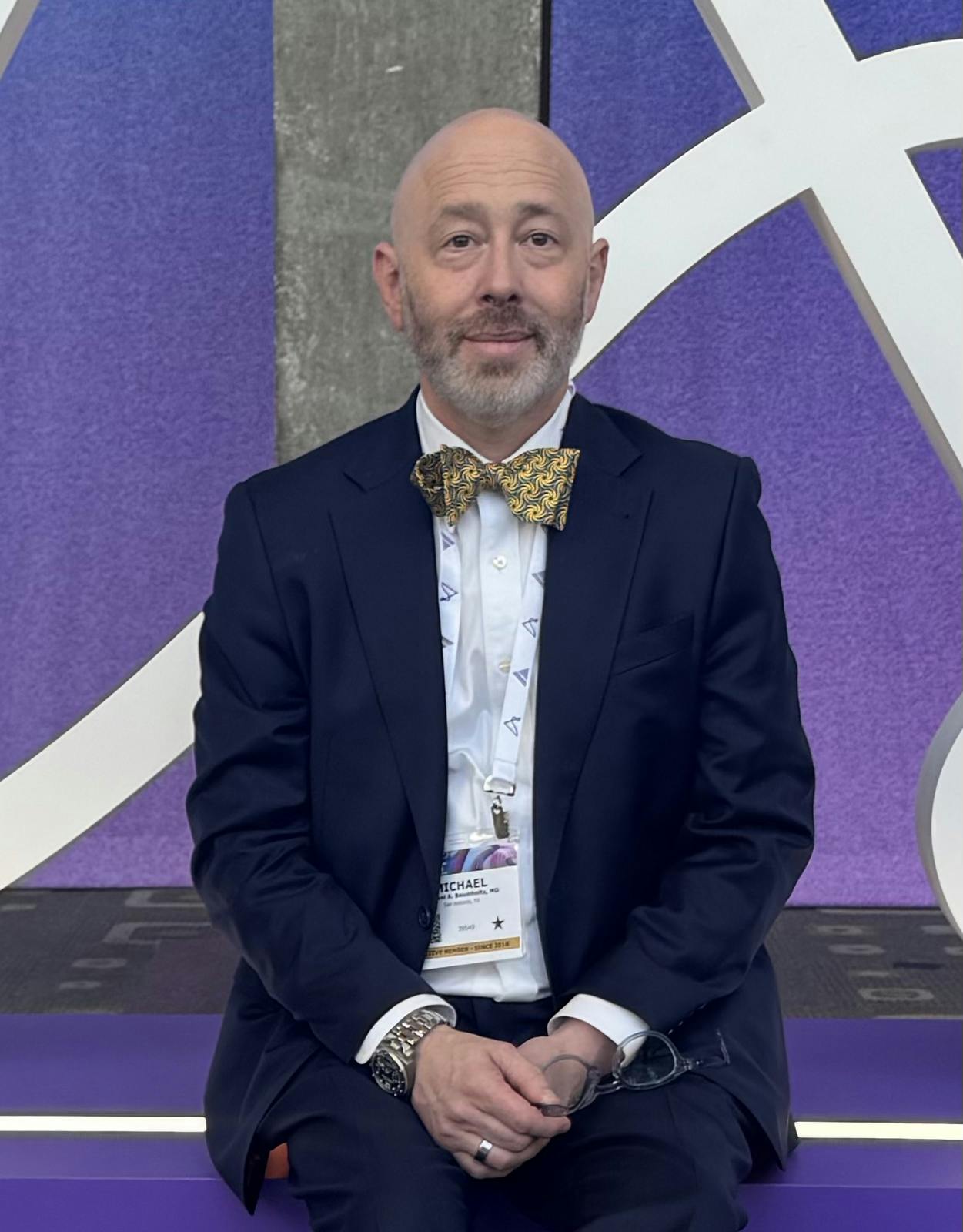
Conoce al Dr. Michael Baumholtz — o simplemente "Dr. B" — uno de los cirujanos plásticos más respetados y confiables de San Antonio. Conocido por su cálida personalidad y su notable precisión, el Dr. B combina la artista, experiencia y comunicación honesta para ofrecer resultados naturales de fomento de la confianza. Los pacientes aprecian que les dice lo que necesitan saber, no sólo lo que quieren escuchar — asegurar que cada transformación se guíe por experiencia, seguridad e integridad.
Con certificados de doble junta en Cirugía General y Plástica, el Dr. B ofrece décadas de formación avanzada de instituciones de clase mundial, incluyendo el Baylor College of Medicine y el University of Texas Health Science Center. Su rara mezcla de excelencia académica, maestría técnica y verdadera compasión le ha hecho cirujano de elección para los pacientes que buscan excelencia estética. Como ex Jefe de Cirugía Plástica de la División en el Hospital Audie L. Murphy VA y educador de futuros cirujanos, establece el estándar de calidad y cuidado.
Más allá del quirófano, el Dr. Baumholtz autorizó o coautorizó más de una docena de publicaciones revisadas por pares y capítulos de libros y entregados más de 40 presentaciones nacionales y regionalesA examinador oral invitado para la Junta Americana de Cirugía Plástica y Executive Committee Member of the Texas Society of Plastic Surgeons, continúa avanzando en la educación quirúrgica mientras mentora a la próxima generación de médicos.
Cuando elija al Dr. B, usted está eligiendo más que un cirujano — estás colaborando con un artista cualificado que escucha, educa y entrega. Su práctica boutique centrada en el paciente ofrece un ambiente tranquilo y solidario donde cada detalle importa, desde la consulta hasta la recuperación.