¿Necesito un lifting de pechos con mis implantes?
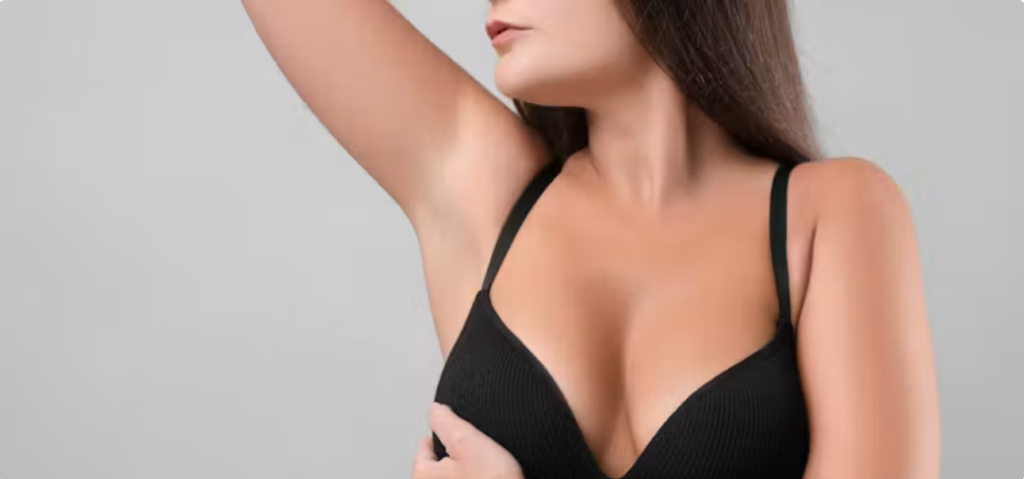
¿Necesito un lifting de pechos con mis implantes?
Implants add volume. They do not lift the nipple. If your nipple has dropped to or below the crease beneath your breast, an implant alone will make the breast larger without making it higher — which is why the position of your nipple, not your cup size, decides whether you need a lift.
Escapadas clave
- Implants fill. Lifts raise. Different problems, different operations.
- Nipple position decides it, assessed against the crease under the breast.
- Revision rate is real: 16.9% in one series of 615 patients.
- Smoking nearly doubles that risk — 27%, and it is in your control.
What an Implant Can and Cannot Do
This is the whole question, and it comes down to one distinction that is easy to miss when you are looking at before-and-after photos.
An implant fills. It sits behind the breast and pushes it forward, adding fullness — particularly in the upper breast, where volume is usually lost first.
A lift repositions. It moves the nipple higher on the chest and removes loose skin so the remaining tissue sits where you want it.
Those are different jobs. An implant placed behind a nipple that has already descended does not carry that nipple upward with it. You end up with more volume in the same low position.
This is why “I’ll just get bigger implants instead of a lift” tends not to work. Extra volume stretches loose skin further rather than taking it up, and the nipple stays where it was.
How the Decision Is Actually Made
Two things get assessed, and neither is about what size you want.
Where your nipple sits
The reference point is the crease underneath your breast — the inframammary fold. Broadly: a nipple sitting above that crease is in reasonable position, and a nipple that has descended to or below it has not.
That single relationship does more to determine whether you need a lift than anything else, and it is assessed by examination rather than from a photograph.
How much sagging there is
Surgeons grade this, most commonly using the Regnault classification, which sorts sagging into grades by how far the nipple has descended.
In the large published series described below, candidacy for a combined lift-and-implant procedure was grade II or higher sagging together with insufficient breast volume. Both halves matter: the sagging is why you need the lift, and the lack of volume is why you need the implant.
Which tells you which operation
- Volume loss, nipple still well positioned → implants alone.
- Good volume, nipple descended → lift alone.
- Ambos → the combined operation, which is what this page is about.
- Mild sagging only → an implant may be enough on its own, by filling behind loose skin.
What Happens If You Skip a Lift You Needed
Worth being specific about, because it is the commonest regret in this area.
You get a bigger breast that still sits low. The nipple continues to point downward, and the implant sits above it rather than behind it, which can make the mismatch more obvious rather than less.
Correcting it afterward means having the lift you avoided — plus a second anesthetic, a second recovery, and a second cost. The avoided operation does not disappear; it just gets postponed at a worse price.
The Numbers, Honestly
Combined lift-and-implant surgery is a more demanding operation than either part alone, and the revision figures reflect that. Here is a large series, with its limitations stated.
615 patients, 1,192 breasts
- Overall revision: 104 of 615 patients — 16.9%
- Poor scarring 5.7% · wound-healing problems 2.9% · areola asymmetry 1.9%
- Loss of nipple sensation 1.3% · recurrent sagging 1.3% · breast asymmetry 1.1%
- Significant infection 1.1% · pseudoptosis 0.8% · hematoma 0.6%
- Capsular contracture (Baker III or higher) 2.4% · implant deflation 2.4%
- No deaths, heart attacks, pulmonary emboli, major flap loss or nipple loss. One deep vein thrombosis.
Read those with three caveats. It is one retrospective series from a single center, not pooled evidence or a trial. Mean follow-up was 17.4 months — which is short for judging recurrent sagging, a problem that develops over years, so 1.3% at under two years should not be read as a long-term rate. And the authors compare their 16.9% favorably against other procedures descriptively, not by statistical test against an implants-only group.
Sixteen point nine percent is a substantial number. It does not mean the operation is a bad idea — it means going in knowing that revision is a realistic possibility rather than a remote one.
Two Things That Raise Your Risk Considerably
Both of these reached statistical significance in that series, and one of them you control entirely.
| Factor | Revision rate | |
|---|---|---|
| Smoking | 27% | vs 16.9% overall · P = .04 |
| Circumareolar lift technique | 23.4% | vs 14.5% for other techniques · P = .01 |
Smoking takes the revision rate to roughly 27% — close to double the overall figure. If you smoke and you are considering this operation, stopping is the highest-value thing you can do for your result, and it costs nothing but difficulty. Ask your surgeon how long before and after surgery they require you to stop, and treat that number as a condition rather than a suggestion.
El circumareolar finding is more technical, but it is a fair question to raise: if your surgeon is planning an incision that circles the areola, it is reasonable to ask why that approach suits you and what they have seen in their own patients.
One Operation or Two?
Briefly, because this deserves its own discussion.
In the series above, doing both in one stage showed no higher risk of complications or revision, and the authors concluded that the risks of combining “are not exponential.” Other surgeons disagree, arguing that two stages give more predictable results and that combined surgery carries a greater likelihood of significant problems.
It is a genuine difference of opinion among experienced surgeons rather than a settled question. The fuller version is here: breast lift with implants — one surgery or two?
Qué pedir en su consulta
Useful questions
- Where is my nipple relative to my breast crease? Ask them to show you.
- What grade of sagging would you put me at?
- Do I need a lift, or would implants alone get me there?
- Which lift technique are you planning, and why that one?
- What is your own revision rate for this operation?
- One stage or two for me, and what makes you say so?
- How long before and after surgery do I need to have stopped smoking?
- What would make you advise against doing both at once?
Whether you need a lift comes down to nipple position, and that is a two-minute answer in person. It is also the question most worth getting right, because getting it wrong means paying for two operations instead of one. Dr. Michael Baumholtz is double board-certified in plastic surgery and general surgery, with more than two decades of experience in San Antonio.
Preguntas Frecuentes
¿Necesito un lifting de senos con mis implantes?
It depends on where your nipple sits, not on how much volume you want. Implants add fullness but do not raise nipple position. If the nipple has descended to or below the crease under the breast, an implant alone will make the breast larger without making it higher, and a lift is what repositions it.
Can breast implants lift sagging breasts?
Only slightly, and only in mild cases. An implant fills the upper breast and can improve the appearance of minimal sagging by adding volume behind loose skin. It does not move the nipple upward. Where sagging is more than mild, an implant on its own tends to produce a larger breast that still sits low.
How do surgeons decide if a lift is needed?
By grading the degree of sagging, commonly using the Regnault classification, and by assessing where the nipple sits relative to the crease beneath the breast. In one large published series, candidacy for a combined lift and implant procedure required grade II or higher ptosis together with insufficient breast volume.
What happens if I get implants without a lift I needed?
The usual outcome is a breast that is larger but still sits low, with the nipple pointing downward and the implant sitting above it rather than behind it. Adding volume to loose skin without repositioning the nipple tends to emphasize the droop rather than correct it, and revising it later means the lift you avoided plus a second recovery.
What is the revision rate for a breast lift with implants?
In a retrospective series of 615 patients, 104 required revision, which is 16.9 percent. That is a substantial figure and worth knowing before surgery. It comes from one single-center series with a mean follow-up of 17.4 months, so it should be read as indicative rather than as a settled rate.
Does smoking affect the outcome of a breast lift with implants?
Substantially. In the same series, smokers had a 27 percent revision rate compared with 16.9 percent overall, and the difference was statistically significant. That is close to double the risk, and it is the single factor on this list that is entirely within a patient’s control before surgery.
Does the type of lift incision affect revision risk?
In that series it did. Circumareolar mastopexy, where the incision circles the areola, carried a 23.4 percent revision rate compared with 14.5 percent for the other techniques, and the difference was statistically significant. It is a reasonable thing to ask your surgeon about when discussing which approach they plan to use.
What are the most common complications of a lift with implants?
In the published series, poor scarring was the most frequent at 5.7 percent, followed by wound-healing problems at 2.9 percent and areola asymmetry at 1.9 percent. Loss of nipple sensation and recurrent sagging were each reported at 1.3 percent. Capsular contracture and implant deflation were each 2.4 percent.
Will my sagging come back after a lift with implants?
Recurrent sagging was reported in 1.3 percent of that series, but mean follow-up was only 17.4 months, which is short for assessing a problem that develops over years. A low figure measured at under two years should not be read as a long-term recurrence rate. Ask your surgeon what they see in their own longer-term patients.
Can I have the lift and implants in one operation?
Often yes. In the series described here, performing both in one stage showed no higher risk of complications or revision than the authors expected, and they concluded the risks are not exponential. Other surgeons argue two stages give more predictable results. It is a genuine difference of opinion worth discussing directly.
Is a lift alone an option instead of implants?
Yes, if you are happy with your volume and only want position corrected. A lift repositions the nipple and reshapes existing tissue without adding size. Combined surgery exists for people who want both repositioning and more volume, which is why the published candidacy criteria include insufficient volume alongside sagging.
La respuesta corta
If your nipple still sits above the crease under your breast, implants alone may be all you need. If it has dropped to or below that crease, an implant will make you larger without making you higher, and a lift is what fixes position.
The combined operation works, and it carries a real revision rate — around 17% in the largest series here, and roughly 27% if you smoke.
Which means the two most useful things you can do are get the nipple-position question answered properly in person, and stop smoking well before the date.
Source
This article is general information and does not replace assessment by a qualified surgeon. Figures come from a single retrospective series with a mean follow-up of 17.4 months and should be read as indicative rather than as expected rates. Last reviewed October 2026.