Recovery After Brachioplasty: A Week-by-Week Guide
Recovery After Brachioplasty: A Week-by-Week Guide
Expect a drain, a compression garment for several weeks, and no heavy lifting or strenuous exercise for at least a month. The scar runs from armpit to elbow and is permanent, though it fades over about a year. Major complications are uncommon, but minor ones are not.
Key takeaways
- Compression for several weeks, no heavy lifting for at least a month.
- The scar may always be visible. That is the trade-off of this operation.
- Numbness can be permanent — in the upper arm or even the forearm.
- Combining with other surgery more than triples the major complication rate.
What the Operation Involves
An arm lift reshapes the underside of the upper arm, from the armpit to the elbow. It is usually performed under general anesthetic and may take up to three hours.
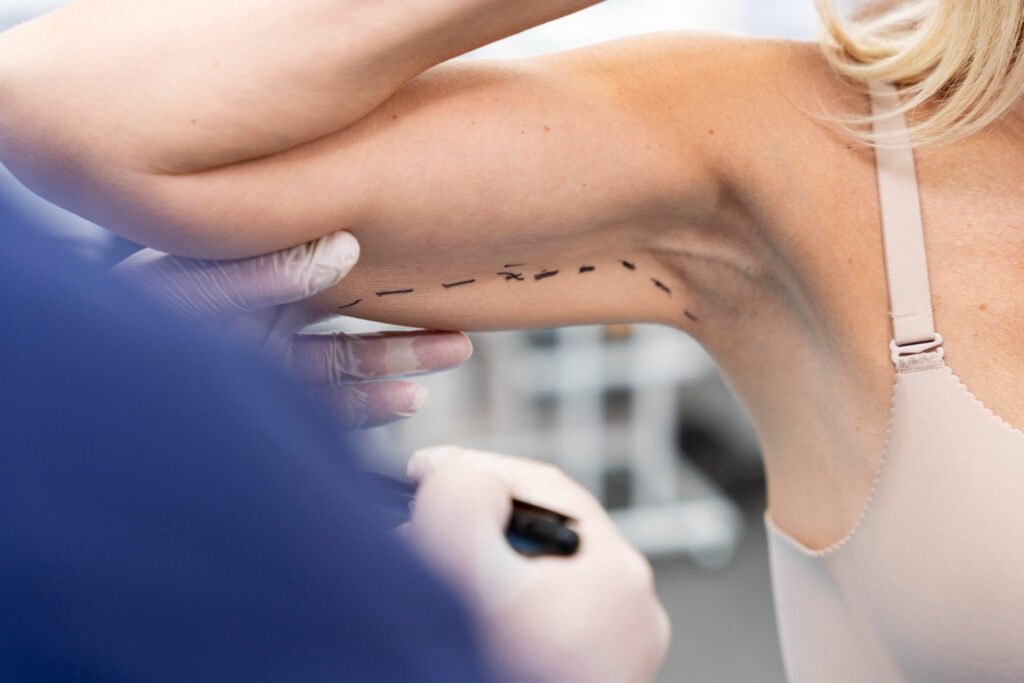
The sequence is: an incision on the inner upper arm — occasionally at the back instead — fat removed by liposuction, the underlying tissue tightened with stitches, the excess skin cut away, and the incision closed.
Which matters for recovery because of that last part. This is a skin-removal operation along a long incision in a part of the body you move constantly and cannot easily keep still.
The Recovery, Week by Week
The first days
- A drainage tube is usually in place, to help prevent fluid building up under the wound.
- Expect bruising, swelling, some numbness, and pain and discomfort.
- Dressings or bandages, plus a compression garment to keep swelling down.
- Rest as much as you can, and follow your wound-care instructions exactly.
- Have help available. Arms are involved in almost everything, which people underestimate.
The first weeks
- Compression continues — published guidance advises wearing the garment for several weeks.
- Swelling begins settling, though it is uneven and the two arms rarely match.
- Drain removal and stitch removal happen in this period, on your surgeon’s schedule rather than a fixed one.
- Still no strenuous exercise and no heavy lifting.
Around one month
- The guidance to avoid strenuous exercise and heavy lifting for at least one month comes to an end — but “at least” is doing real work in that phrase. Your surgeon decides when you resume, not the calendar.
- The incision line is still red and firm. That is normal at this stage.
Three months to a year
- Swelling continues to resolve and the arm contour becomes genuinely visible.
- The scar fades gradually. Published guidance puts meaningful improvement at around a year or so.
- Where numbness has not resolved by this stage, that is worth discussing with your surgeon.
Several specifics are deliberately not given numbers here — length of hospital stay, exactly when the drain and stitches come out, when you can drive, when you return to work, and how soon you can reach overhead. Published patient guidance does not cover those, and they vary with how much was removed and how you are healing. Ask at your pre-operative appointment and write the answers down.
Swelling and Numbness
Two things that worry people, and they are not equivalent.
Swelling
Expected, and prolonged swelling is a recognized possibility rather than a sign of failure. The compression garment is doing real work here, which is why wearing it as instructed matters more than it feels like it should.
Numbness — and the part most pages soften
This risk is permanent-change territory
Some numbness early is expected and usually settles. But sensory nerve injury is a listed risk of this operation, and published guidance states it may cause prolonged or permanent numbness in the upper arm or even in the forearm.
That is worth understanding before surgery rather than afterward. It is not common, and it is not a reason to avoid the operation — but “temporary numbness,” which is how most pages describe it, is not the complete picture.
The Scar, Honestly
It runs along the inside of the upper arm, armpit to elbow. Published guidance is unusually direct: the scar will be permanent and may always be visible, though it should fade in time, with improvement taking around a year or so.
This is the central trade-off of brachioplasty, and it is the thing to be certain about before booking. You are exchanging loose skin for a long scar in a place that short sleeves do not cover.
Where that trade-off can sometimes be reduced — and where it cannot — is covered separately: what is an “invisible” arm lift?
What the Complication Figures Actually Mean
This is where most pages mislead, not deliberately but by quoting one number without saying what it counts.
A database study of 2,294 patients
- Major complications: 3.4% — defined as requiring an emergency room visit, hospital admission, or reoperation within 30 days.
- Infection 1.7% · Hematoma 1.1%
- Body mass index of 30 or above was an independent risk factor.
- Men were more likely than women to develop a hematoma.
3.4% sounds reassuring, and for major complications it is. But compare it with what earlier studies reported: a 2006 Mayo Clinic series found 25% overall complications with a 12.5% revision rate, and a 2013 multi-practice study found 17.7% major and 44.8% minor complications, with a 22.9% revision rate.
Those numbers are not in conflict
They measure different things. The 3.4% figure counts only major problems inside 30 days. The older studies counted everything.
So the honest summary is two sentences, not one: major complications are uncommon. Minor complications are not — and revision rates in the older series ran between roughly 12% and 23%.
Anyone quoting 3.4% as the complication rate for arm lifts is quoting it accurately and incompletely.
The Combining Decision
This is the most actionable finding in the data, and it matters most to exactly the patients most likely to be offered a combination.
| Major complication rate | |
|---|---|
| Brachioplasty alone | 1.3% |
| Combined with other procedures | 4.4% |
More than triple. If you have had major weight loss and are being offered an arm lift alongside other contouring, that is a genuine trade-off to weigh rather than a technicality — convenience and a single recovery on one side, a meaningfully higher complication rate on the other.
It is a fair question to put to a surgeon directly: what does combining do to my risk, specifically?
Report to your surgeon
- Any bleeding, severe pain, or symptoms that seem unusual to you
- An incision opening, separating or breaking down
- Increasing redness, warmth or spreading discoloration
- Drainage or pus from the incision
- Fever
- A sudden increase in swelling or firmness
- Numbness that is getting worse rather than better
Seek emergency care immediately for chest pain, shortness of breath, or pain, swelling, warmth or tenderness in a calf or leg. Blood clots are a listed risk of this surgery and can cause life-threatening complications.
What to Ask Before Surgery
The questions that save confusion later
- How long will I wear the compression garment?
- When does the drain come out, and the stitches?
- How long before I can drive?
- How long off work, for my job specifically?
- When can I reach overhead or lift my arms properly?
- Exactly where will my scar run, and how long will it be?
- What is my risk of lasting numbness?
- If we combine procedures, what does that do to my risk?
- Would you advise I lose weight first?
Write the answers down. Several of these are the specifics no general guide can give you, and they are the ones you will want at week two.
The question worth settling before anything else is the scar. It is permanent, it runs armpit to elbow, and no technique makes it disappear — so being clear-eyed about that trade-off matters more than any recovery detail. Dr. Michael Baumholtz is double board-certified in plastic surgery and general surgery, with more than two decades of experience in San Antonio.
Frequently Asked Questions
How long does brachioplasty recovery take?
Expect a compression garment for several weeks and no strenuous exercise or heavy lifting for at least one month. A drain is usually placed initially. The scar continues improving for around a year. Your surgeon sets your specific timeline for returning to work, driving and normal activity.
What does an arm lift involve?
It reshapes the underside of the upper arm from the armpit to the elbow. It is usually performed under general anesthetic and may take up to three hours. The surgeon makes an incision on the inner upper arm, removes fat with liposuction, tightens the underlying tissue with stitches, excises the excess skin and closes.
How long do I wear the compression garment after an arm lift?
Published patient guidance advises wearing it for several weeks to help keep swelling down. The precise duration is your surgeon’s decision and depends on how much was removed and how you are healing, so follow the instruction you were given rather than a general figure.
Will I have a drain after brachioplasty?
Usually yes. A drainage tube is commonly placed in the wound to help prevent fluid building up underneath. When it comes out depends on how much fluid it is collecting, which is why that timing comes from your surgeon rather than from a fixed schedule.
How bad is the arm lift scar?
It runs along the inside of the upper arm from armpit to elbow, and published guidance is direct about it: the scar will be permanent and may always be visible, though it should fade in time, with improvement taking around a year or so. This is the central trade-off of the operation.
Can numbness after an arm lift be permanent?
Yes. Some numbness is expected early and usually settles, but sensory nerve damage is a recognized risk and can cause prolonged or permanent numbness in the upper arm or even the forearm. That is worth understanding before surgery rather than discovering afterward.
What are the complication rates for brachioplasty?
A database study of 2,294 patients found a 3.4 percent rate of major complications, meaning those needing an emergency visit, hospital admission or reoperation within 30 days, with infection at 1.7 percent and hematoma at 1.1 percent. Minor complications are considerably more common, and earlier studies reported overall rates as high as 25 percent.
Why do complication rates vary so much between studies?
Because they measure different things. The 3.4 percent figure counts only major complications within 30 days. Older studies counted everything, including minor problems, and one reported 44.8 percent minor complications alongside 17.7 percent major. Major problems are uncommon; minor ones are not, and a single headline percentage hides that.
Does combining an arm lift with other surgery increase the risk?
Substantially. In the same database study, combined procedures carried a 4.4 percent major complication rate compared with 1.3 percent for brachioplasty performed alone. That is more than triple, and it is worth weighing seriously if you are considering combining an arm lift with other body contouring.
Does my weight affect brachioplasty risk?
A body mass index of 30 or above was identified as an independent risk factor for major complications in that study. It does not rule the operation out, but it is a factor your surgeon will weigh, and some patients are advised to reduce their BMI before surgery.
When can I lift my arms or reach overhead after an arm lift?
Your surgeon sets this, and it is one of the specifics published patient guidance does not cover. What is advised generally is avoiding strenuous exercise and heavy lifting for at least one month. Ask directly at your pre-operative appointment and write the answer down.
When should I contact my surgeon after an arm lift?
Report any bleeding, severe pain or unusual symptoms. Contact them the same day for an incision opening or breaking down, increasing redness or warmth, drainage, fever, or a sudden increase in swelling or firmness. Seek emergency care for chest pain, breathlessness, or calf pain and swelling, which can indicate a blood clot.
The Short Answer
Drain in the first days, compression garment for several weeks, no heavy lifting or strenuous exercise for at least a month, and a contour that becomes genuinely visible as swelling settles over the following months.
The scar is permanent, runs armpit to elbow, and takes about a year to fade as far as it is going to. Lasting numbness is an uncommon but real possibility rather than a purely temporary one.
And if you are being offered an arm lift alongside other surgery, know that combining more than triples the major complication rate — 4.4% against 1.3%. That is a conversation worth having before you agree to it.
Sources
- Better Health Channel, Victoria Department of Health — Brachioplasty (arm lift surgery)
- Aesthetic Surgery Journal — brachioplasty complications, CosmetAssure database of 2,294 patients
This article is general information and does not replace the post-operative instructions you receive from your own surgeon. Several timings deliberately defer to your surgeon because published general guidance does not specify them. Last reviewed October 2026.