

Can Gynecomastia Go Away On Its Own Or Will I Need Surgery?

Gynecomastia is more than a cosmetic concern. It affects confidence, clothing choices, gym routines, and how a man shows up at work and with family. Many readers of this page are women in a supportive role. They are partners, mothers, daughters, or friends who want clear answers for someone they care about. Dr Michael Baumholtz, Plastic Surgeon in San Antonio, TX, addresses the question they ask most often.
Will this go away if we wait, or is surgery the predictable way to a flatter, natural looking chest. His perspective is steady and practical. He explains what the fullness is, how it behaves over time, and which steps actually move the needle.
At Baumholtz Plastic Surgery, the approach is calm and honest. Some fullness settles with time, weight change, or removal of a known trigger. Firm, long standing glandular tissue usually does not. The first task is to decide what type of tissue is present. Once the cause and timeline are clear, decisions become simpler and less stressful. Dr Michael Baumholtz believes that good choices begin with good information. This page offers that information in plain, useful language for families across San Antonio and South Texas.
Ready for Surgery? Take Dr Baumholtz Surgery Quiz
What Gynecomastia Is And What It Isn’t
True gynecomastia is always a combination of fatty tissue and glandular tissue. Pseudo Gynecomastia is only fatty tissue. This is an important distinction because treatments are different.
Gynecomastia describes enlargement of the male breast area. That enlargement can come from firm glandular tissue, soft fatty tissue, or a mix of both. When gland dominates, a small but distinct disc sits beneath the nipple areola. It feels rubbery or springy and it pushes the nipple forward. When fat dominates, the chest feels soft and blends into the upper abdomen. Many men have a mix, and the proportions can differ from one side to the other. This distinction matters because gland and fat behave differently.
Fat responds to weight change and overall fitness. Gland does not. No diet, workout plan, or cream can dissolve dense gland. Accepting this saves months of frustration and detours into unproven shortcuts. Skin thickness also matters. Thicker skin hides minor transitions and shadows. Thin skin shows every ridge and valley. Baseline differences in the ribcage and chest muscles are common. These details shape the plan so the final contour reads as natural in light, movement, and clothing.
Can It Go Away On Its Own? The Time Factor
Time can help some men, especially during the teens and early twenties when hormones settle. If weight has fluctuated, a return to healthier routines may reduce a fat dominant chest. If a medication, supplement, or anabolic agent is a trigger, removing it may allow tissue to soften over months. These possibilities are real and worth pursuing when the story and the exam support them. When exogenous substances such as steroids or other drugs are involved, Dr Michael Baumholtz consults with Endocrinology. They may choose to trial a blocking agent to see if there can be an improvement. Even when this is successful, there is often residual gland or skin.
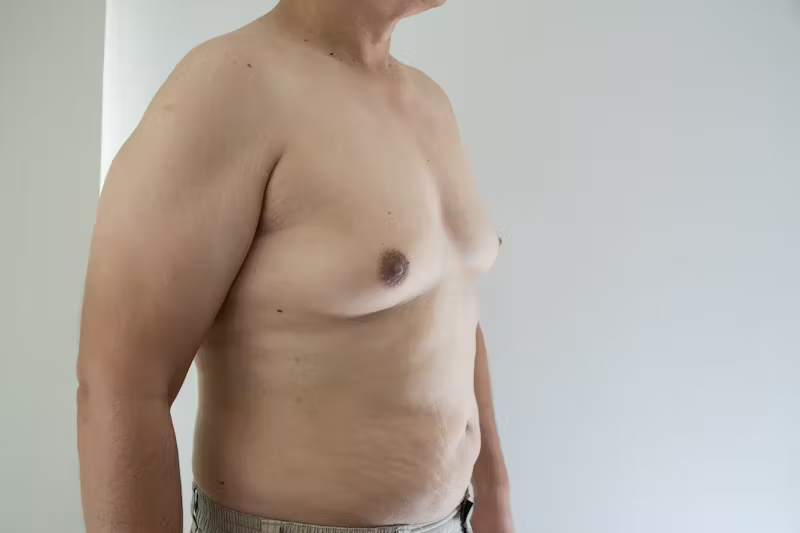
The opposite pattern is just as important to recognize. When a firm subareolar disc has been present for a long period without change, spontaneous resolution is unlikely. Men often give it more time and add more gym sessions, hoping to see the mound shrink. When gland is the primary component, the mound rarely fades. Pairing texture with timeline keeps the plan realistic. Soft, recent fullness can improve with weight stability and healthy habits. Firm, long standing tissue typically persists. Tender tissue can calm with time.
Painless firmness is usually stable. One sided enlargement that never budges deserves attention because persistent asymmetry rarely disappears on its own. This time based lens prevents over treating cases that would self resolve while sparing others the fatigue of waiting out a problem that is unlikely to change. Dr Michael Baumholtz uses this lens in every consultation so that expectations match reality.
The Decision Framework: How Families Can Think It Through
Clear decisions come from a few simple questions. What is causing the fullness. How long has it been present. How pronounced is the mound. How much does it interfere with daily comfort and confidence. The answers point naturally toward watchful waiting or toward surgery. Families can apply the same structure at home. They can feel gently around the areola to check for a firm disc. They can look back at old photos to see when the change appeared and whether it shifted with weight loss or training.
They can review prescriptions, over the counter products, and supplements. Most of all, they can be honest about goals. If the priority is wearing fitted shirts without a visible mound, swimming without hesitation, or ending a nagging ache, the plan should be built to make those specific changes likely. When the framework points to short lived, soft fullness with a clear trigger, observation is reasonable. When it points to persistent firmness with meaningful self consciousness or discomfort, surgery becomes a sensible and predictable choice. The aim is not to push anyone toward an operation. The aim is to match the plan to the person and to what the anatomy will allow.
What Helps Without An Operation And What Doesn’t
Lifestyle change always has value. Thoughtful nutrition, consistent training, and better sleep improve health and body composition. As body fat decreases, a fat heavy chest becomes less prominent. Posture work through the upper back and core changes how shirts drape and how the chest appears in motion. A registered dietitian or experienced trainer can streamline progress and keep it sustainable.
There are limits to what non operative measures can deliver. Dense gland does not respond to calories burned or targeted chest work. Devices marketed for spot reduction do not remove gland and do not tighten stretched skin. Topical creams and unregulated supplements promise shortcuts that do not exist. Accepting these limits prevents months of trial and error that end in the same place. In the clinic, the team supports non operative strategies when they are appropriate and pivots to definitive options when they are not. The conversation remains practical and respectful.
When Surgery Is The Predictable Path
Surgery enters the conversation when the tissue is firm, longstanding, and clearly responsible for the projection of the nipple areola. It also enters the conversation when asymmetry affects clothing, when tenderness persists after a period of observation, or when skin laxity after weight changes leaves a heavy chest that chafes and restricts activity. In these situations, surgery is not a last resort. It is the right tool for the job. The goal is a flatter, natural looking chest that fits the frame.
The plan aims for enough reduction to change day to day life without creating a hollow. Removing too much tissue can leave a crater and visible irregularities. Removing too little fails to address the reasons people seek help. Between those two extremes is a measured resection that respects anatomy and produces a chest that looks like the patient, only more at ease in clothing and in motion. This is where surgeon judgment matters. Dr Michael Baumholtz brings a steady, revision capable mindset to each case so the result is dependable and proportional.
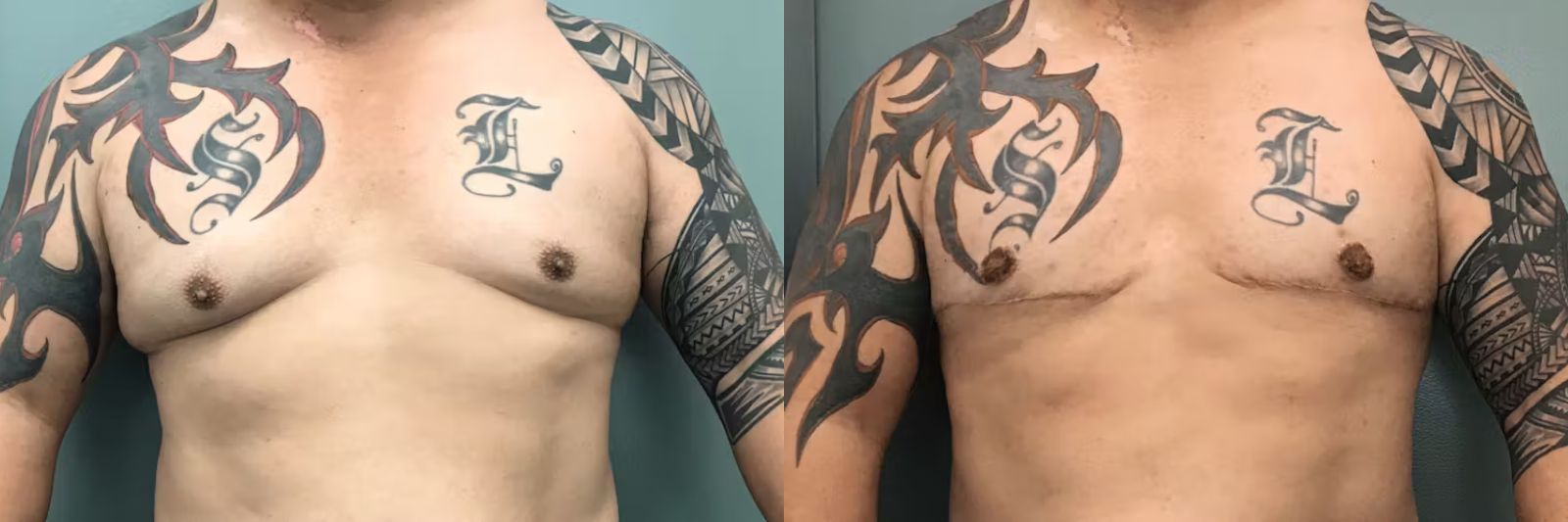
See Before and After Photos of Gynecomastia Surgery
How Dr Michael Baumholtz Approaches Treatment
Dr Michael Baumholtz, Plastic Surgeon in San Antonio, TX, is dual board certified in General Surgery and Plastic Surgery. He is known for clear communication, conservative planning, and strong follow through. He treats a wide range of cases, from small, stubborn glands in lean men to large, skin heavy chests after major weight loss. Across that spectrum, his process stays consistent. Identify the tissue. Choose the least invasive technique that will reliably solve the problem. Support healing with attentive aftercare.
The Go To Technique For Most Patients
For most men, the preferred strategy combines power assisted liposuction with targeted reduction of dense gland through small, hidden incisions. Liposuction sculpts the surrounding fat to avoid a harsh step off. Focused reduction of gland flattens the mound without leaving a crater. Incisions are placed to blend with natural borders, often at the edge of the areola or in a chest shadow so they stay quiet once healed. Throughout the case, contour is checked from multiple angles and with gentle arm movement so the chest looks right when standing, sitting, and reaching.
Compression is part of the treatment, not an afterthought. A supportive medical grade garment is applied in the operating room and worn as directed, commonly for about six weeks. The garment helps swelling recede, encourages the skin envelope to conform to the new shape, and lowers the chance of fluid buildup. Drains are generally not required with this limited incision method, which simplifies early care at home.
When The Chest Is Larger Or The Skin Is Loose
Some men present with large, ptotic chests. This pattern is common after major weight loss or long standing glandular growth. In these cases, removing tissue alone is not enough. The excess skin must be addressed to achieve a flatter, stable silhouette. Skin reducing techniques remove and redrape the envelope while reshaping the underlying tissues. In select severe cases, a free nipple graft repositions the areola on the new chest surface. This restores proportion when the original position would be too low. These operations trade longer scars for a result that truly changes comfort and wardrobe options. Scar placement is planned along natural lines when possible. Aftercare focuses on scar maturation with sun protection, silicone based support, and time. Drains are used when appropriate to protect the result and improve comfort during early healing.
Anesthesia, Comfort, And Safety
All procedures are performed under general anesthesia with a board certified anesthesia team. Comfort is managed with a multimodal plan that emphasizes non narcotic medicines while preserving the option for additional support if needed. Measures during surgery reduce the risk of blood clots. Meticulous sterile technique protects against infection. The practice encourages early walking, careful position changes, and a return to activity based on how the tissues are healing rather than the calendar alone.
Surgery Day At Baumholtz Plastic Surgery
Surgery day is designed to feel organized and unhurried. Patients arrive for check in, photographs that support planning and follow up, and a final review of the plan with Dr Michael Baumholtz. Markings are placed to map natural borders and the small access points used for liposuction and gland reduction. This visual roadmap helps preserve symmetry and smooth transitions as the operation progresses. In the operating room, anesthesia is induced, sterile prep is completed, and the sequence moves step by step. Liposuction refines the borders and reduces fat. Focused reduction of gland follows through small incisions positioned to remain discreet once healed. Contour is assessed repeatedly from different angles to ensure a flat chest without a scooped appearance. Incisions are closed, dressings are applied, and the compression garment is placed while the patient is still asleep so support begins immediately. Recovery begins in the on site suite. Nursing staff monitor comfort, hydration, and orientation. Before discharge, the team reviews written instructions and the direct contact pathway back to the practice. A trusted adult escorts the patient home. The rhythm is steady. The instructions are specific. The plan for the first night is clear.
Recovery, Results, And The New Normal
Recovery is a progression rather than a switch. In the first few days, tightness and pressure are common. Short, frequent walks improve circulation and reduce stiffness. Sleep with slight elevation and keep the garment on as directed. By the end of the first week, bruising starts to fade and comfort improves. Some men return to light desk work as soreness allows, with the timeline tailored to the individual and the extent of surgery. During weeks two and three, swelling gradually diminishes. The chest looks flatter while the underlying tissues feel firm as they knit together. Around one month, activity expands under guidance. Gentle cardio is often comfortable while heavy lifting and direct chest strain wait until clearance is given. After six weeks, most routine activities resume and attention turns to refinement. Scar care begins when incisions are closed and the surgeon approves topical support. Sun protection is essential during the first year because ultraviolet exposure can darken scars. Silicone based support can help maturation. Gentle massage softens thicker areas over time. Sensation around the nipple areola may fluctuate. Temporary numbness or tingling is common and tends to improve across several months. Results evolve as swelling recedes and tissues soften. Final appearance depends on baseline anatomy, skin quality, and individual healing. No surgeon can guarantee a specific outcome. Dr Michael Baumholtz can promise thoughtful planning, a measured technique, and steady follow up that keeps small concerns small.
Safety First: Sensible Precautions
Safety guides every choice in this practice. Candidacy is assessed with a careful review of health history, medications, and prior procedures. Nicotine use is a barrier to elective aesthetic surgery because it compromises blood flow and wound healing. The practice requires cessation before surgery and maintains that expectation throughout recovery. This single step meaningfully reduces complications. Medication and supplement management also matters. Some agents increase bleeding or interact with anesthesia. Patients receive a clear stop and start list so the lead up to surgery is structured and predictable. The known risks of any operation are discussed in plain English. These include bleeding, infection, fluid accumulation, contour irregularity, asymmetry, scarring concerns, and changes in nipple sensation. The plan aims to reduce each risk and to identify any issue early if it arises. Follow up is scheduled and access to the team remains open. Patients are encouraged to reach out rather than wonder.
Cost, Timing, And Practical Logistics In San Antonio, TX
Gynecomastia surgery at this practice is a private pay service. Insurance coverage for aesthetic chest contouring is uncommon. Pricing reflects the amount and quality of tissue to address, the need for skin management, operative time, anesthesia, and aftercare resources. Because each chest is different, precise estimates follow an in person examination. Dr Michael Baumholtz does not take insurance. The office provides transparent pricing and guidance on payment options so families can plan with confidence. Planning around real life makes recovery smoother. Many men choose a window that avoids major work deadlines or family events. Setting up a simple recovery space at home improves comfort. A supportive chair, extra pillows, a place for water and medications, and easy access to chargers and entertainment help the first week go well. Having a second compression garment available once permitted makes daily routines easier. Return to work is individualized. Many desk roles resume within one to two weeks depending on comfort and the scope of surgery. Driving on the day of surgery is not allowed and a responsible adult is required for the trip home. San Antonio is straightforward for travel. Patients coming from across South Texas often choose nearby hotels for the first night. The practice advises on the timing of travel and virtual check ins so out of town logistics feel manageable. The focus is to make planning simple so energy can remain on healing.
The Role Of The Support System
Partners and parents often begin the conversation. They carry the emotional weight of watching someone avoid activities they once enjoyed. Their support matters. Practical help with rides, light meals, and reminders eases the early days. Respect for privacy builds trust and comfort. Celebrating small wins keeps momentum going. The first comfortable tee shirt. The first pool day without scouting for cover. Standing taller in photos without adjusting posture. Support also means patience. Healing follows a curve, not a straight line. There will be days when swelling seems stubborn and days when the mirror looks dramatically different. Families who understand this rhythm provide space for confidence to grow. The team encourages open communication so that concerns are addressed quickly and progress is recognized.
Why Families In San Antonio Choose Dr Michael Baumholtz
Families choose Dr Michael Baumholtz, Plastic Surgeon, for steady judgment, respectful communication, and an emphasis on safety that never wavers. Dual board certification in General Surgery and Plastic Surgery reflects broad training and comfort with both routine and challenging cases. The practice culture values privacy, preparation, and attentive follow up. Patients meet their surgeon, have access to him before and after surgery, and know who will be there if a question arises. Local access matters. Being cared for in San Antonio makes in person follow up simple. It allows the practice to respond quickly if something needs attention. Many families describe the experience as organized and respectful from the first call to the last visit. The results look like the person they know, only more comfortable and confident in daily life. That is the goal, and it guides the work every day.
Real Life Scenarios (Anonymized)
A high school swimmer arrives with rounded shoulders and shirts a size too big. Because the change is recent and tissue is tender, the recommendation is to wait while hormones settle and lifestyle habits improve. Months later, the tenderness fades but a firm disc persists without change. A minimal incision procedure removes the gland and shapes the surrounding fat. The first time he wears the team shirt without hesitation, his posture tells the story. A new father steps into the clinic after a demanding year. Sleep is limited, workouts are inconsistent, and weight is up. He invests in nutrition, walking, and resistance training. The overall shape improves, yet a distinct bulge remains under one nipple. A short, carefully planned operation flattens the mound without leaving a hollow. He returns to work as comfort allows and resumes training with guidance. An executive who travels frequently describes an asymmetric chest that shows under fitted dress shirts. He is lean and otherwise fit. Imaging is not required. The exam identifies a small, dense gland on one side. A brief, targeted procedure under general anesthesia corrects the imbalance. The difference is quiet but meaningful in clothing and in daily interactions. A weekend warrior who lost a substantial amount of weight presents with skin laxity and a large, ptotic chest that chafes during exercise. For him, the right answer is a skin reducing technique with careful nipple areola repositioning. Scars are longer, but the shape is stable and clothes fit comfortably. He describes the change as liberating. Movement without friction and a body that matches the effort invested.
How To Prepare For A Thoughtful Consultation
Preparation makes the first visit productive. Arriving with a list of medications and supplements, a concise medical history, and an understanding of recent weight changes provides context. Bringing a simple set of goals helps the discussion. It can be as basic as wanting a tee shirt to sit flat or no longer avoiding pool days and photos. During the consultation, the exam distinguishes fat from gland and evaluates skin quality. The conversation that follows is in plain English. Options, tradeoffs, incision locations, recovery, and likely timelines are explained without pressure. The plan that emerges is specific to the person rather than a template. Dr Michael Baumholtz, Plastic Surgeon in San Antonio, TX, values collaboration and patience so choices feel informed, not rushed. By the end of the visit, most families feel they have a map. They know what to do if observation is appropriate and what to expect if surgery is chosen. They understand how long healing takes, what activities look like at each step, and how to reach the team if something feels off. That clarity lowers stress and supports better outcomes.
Key Takeaways
True gynecomastia is always a combination of fatty tissue and glandular tissue. Pseudo Gynecomastia is only fatty tissue. This distinction matters because treatments are different. Some gynecomastia settles with time or lifestyle change, particularly when fullness is soft and recent. A firm, long standing gland rarely goes away on its own. When gland dominates, surgery is the predictable way to achieve a flatter, natural looking chest. Limited incision techniques suit most men. Skin reducing approaches are reserved for larger, ptotic chests. Safety anchors every step. Anesthesia, garment use, nicotine policy, and structured follow up are built into the plan. For families across San Antonio, Dr Michael Baumholtz offers case by case guidance, clear expectations, and consistent aftercare.
FAQs About Gynecomastia Improving On Its Own Or Needing Surgery
If the chest looks flatter in the morning but fuller by evening, does that mean it will go away without surgery?
Daily fluid shifts and normal activity can make the chest look different at different times. If a firm disc can be felt under the areola, that is gland. Gland does not disappear with time, even if the contour fluctuates during the day. Dr Michael Baumholtz recommends using time and touch as guides. Short duration plus soft fullness may improve. Long duration plus a firm disc usually means surgery is the predictable fix.Can targeted chest workouts press the gland flatter or move it to the side?
Exercise strengthens muscle and improves posture, but it cannot flatten or relocate glandular tissue. In some men, building the pectoral muscle can make a firm mound look more pronounced against a stronger chest. Training remains valuable for health and confidence. It just is not a substitute for removing gland when gland is the problem.He stopped anabolic agents or a suspect supplement months ago and labs are normal. Should the family wait longer or consider surgery now?
Once a known trigger is removed, it is reasonable to allow several months for tenderness to settle. If a firm subareolar mass persists and the shape has not changed with stable weight and time, surgery becomes a sensible next step. Dr Michael Baumholtz discusses timing case by case so the plan is safe, efficient, and aligned with goals.Is a very low body fat percentage required before surgery, or can he proceed while still on a fitness journey?
A stable weight is more important than a specific number. Being at a comfortable, maintainable weight helps with planning and with keeping results consistent over time. Surgery can be appropriate before reaching an ambitious fitness target, as long as expectations are realistic and weight will not swing dramatically afterward. Dr Michael Baumholtz will outline the tradeoffs so timing fits real life.Do compression shirts, taping, or ice change gland size permanently?
Compression can hide projection in clothing and improve comfort. Taping and ice may reduce short term swelling after a workout or during recovery. None of these methods remove gland or produce a lasting change in contour. They are supportive measures, not definitive treatment.What does it really mean when someone says the gynecomastia came back months after surgery?
Early on, swelling and firm scar tissue can make the chest feel lumpy. That is part of normal healing and usually settles with time, massage when approved, and garment use. True regrowth is uncommon after a careful operation. When it does occur, a persistent hormonal trigger, significant weight change, or new medications are often involved. Dr Michael Baumholtz evaluates the story, the exam, and the timeline to separate normal recovery from a genuine recurrence.How can a family tell at home whether this is mostly fat or mostly gland without imaging?
Gently pinch around the areola. A firm, coin shaped disc that pushes the nipple forward suggests gland. Soft, even fullness that thins with overall weight loss suggests fat. Old photos help establish timing. Final assessment belongs in a consultation where texture, skin quality, and symmetry are evaluated together. In San Antonio, Dr Michael Baumholtz uses a straightforward exam and a clear discussion to confirm the diagnosis and map the next steps.Medical References
- Enlarged breasts in men (gynecomastia). Mayo Clinic. https://www.mayoclinic.org/diseases-conditions/gynecomastia/diagnosis-treatment/drc-20351799
- EAA clinical practice guidelines—gynecomastia evaluation and management. https://onlinelibrary.wiley.com/doi/10.1111/andr.12636
- Gynecomastia: Pathophysiology, Evaluation, and Management. PMC. https://pmc.ncbi.nlm.nih.gov/articles/PMC2770912/
- Gynecomastia: Etiology, Diagnosis, and Treatment. Endotext. https://www.ncbi.nlm.nih.gov/books/NBK279105/
- Gynecomastia: Clinical evaluation and management. PMC. https://pmc.ncbi.nlm.nih.gov/articles/PMC3987263/
- Gynecomastia: Practice Essentials, Background, Etiology. Medscape. https://emedicine.medscape.com/article/120858-overview
- Breast Reduction Surgery and Gynecomastia Surgery. Aetna. https://www.aetna.com/cpb/medical/data/1_99/0017.html
Call To Action
If you are weighing watchful waiting against a more definitive solution, now is a good time to get clear answers. Schedule a private consultation with Dr Michael Baumholtz, Plastic Surgeon, at Baumholtz Plastic Surgery in San Antonio, TX. The visit will focus on cause, timeline, and the safest path to a flatter, natural looking chest. Thoughtful planning, realistic goals, and respect for privacy guide every step.
Further Reading
- Read Dr Baumholtz Blog on What Are Moobs And How Can You Lose Them?
- Read Dr Baumholtz Blog on Chest Liposuction or Gland Removal for Gynecomastia or Both
- Read Dr Baumholtz Blog on How to Get Rid of Puffy Nipples in Men: Surgical and Non-Surgical Options
Baumholz Plastic Surgery with Dr. Baumholtz in San Antonio
ABOUT DR. MICHAEL BAUMHOLTZ
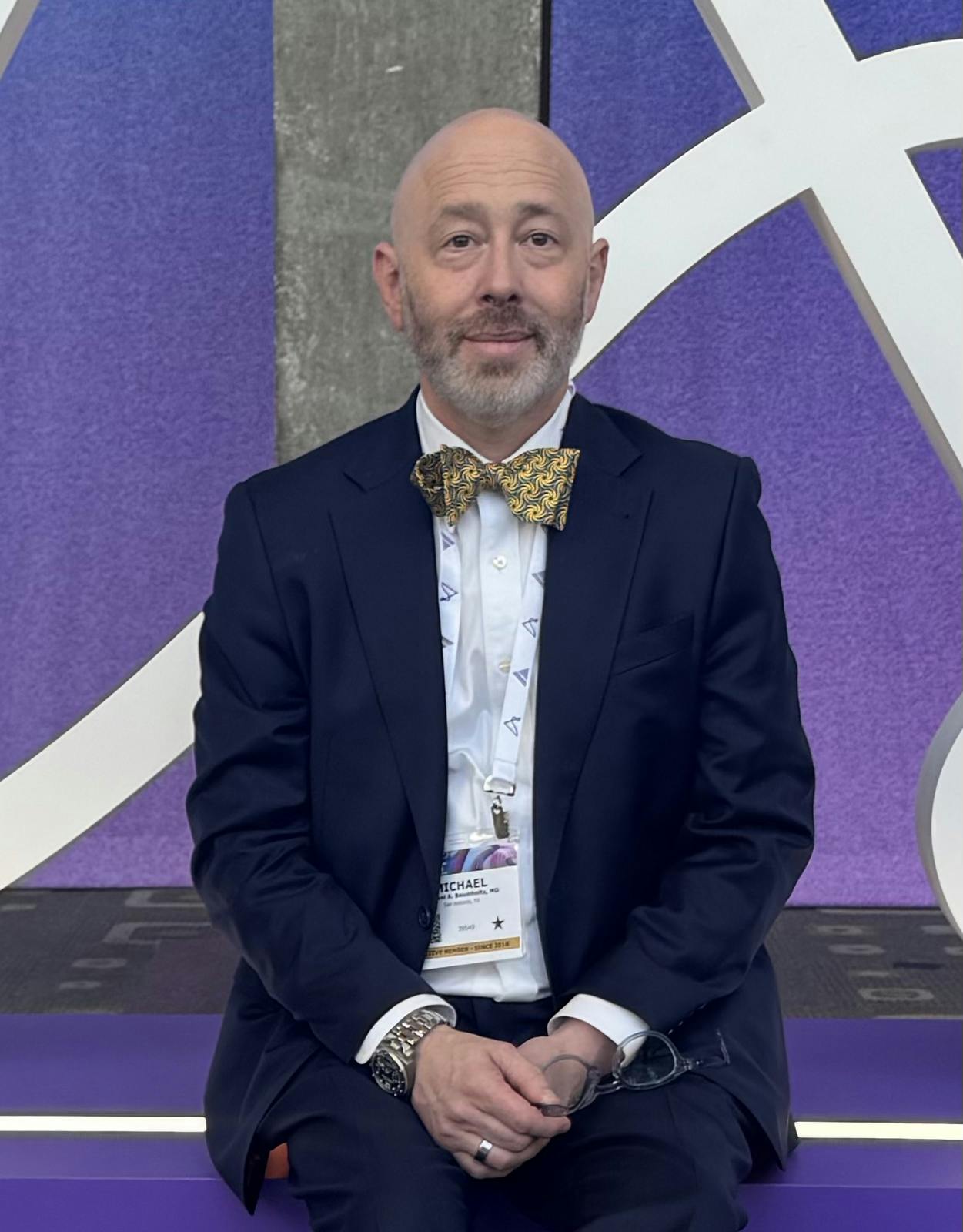
Meet Dr. Michael Baumholtz — or simply “Dr. B” — one of San Antonio’s most respected and trusted board-certified plastic surgeons. Known for his warm personality and remarkable precision, Dr. B combines artistry, experience, and honest communication to deliver natural, confidence-building results. Patients appreciate that he tells them what they need to know, not just what they want to hear — ensuring every transformation is guided by expertise, safety, and integrity.
With dual board certifications in General and Plastic Surgery, Dr. B brings decades of advanced training from world-class institutions including Baylor College of Medicine and the University of Texas Health Science Center. His rare blend of academic excellence, technical mastery, and genuine compassion has made him the surgeon of choice for discerning patients seeking aesthetic excellence. As former Division Chief of Plastic Surgery at the Audie L. Murphy VA Hospital and an educator of future surgeons, he sets the standard for quality and care.
Beyond the operating room, Dr. Baumholtz has authored or co-authored more than a dozen peer-reviewed publications and book chapters and delivered over 40 national and regional presentations. A guest oral examiner for the American Board of Plastic Surgery and Executive Committee Member of the Texas Society of Plastic Surgeons, he continues to advance surgical education while mentoring the next generation of physicians.
When you choose Dr. B, you’re choosing more than a surgeon — you’re partnering with a skilled artist who listens, educates, and delivers. His boutique, patient-focused practice offers a calm, supportive environment where every detail matters, from consultation to recovery.